Angkor Wat history.
The Angkor Wat complete history: The Greatest Temple in the World . Visit Angkor Wat
Angkor Wat is not only the most famous monument in Cambodia — it is one of the greatest architectural achievements in human history. Located near Siem Reap, Angkor Wat represents the spiritual heart of the ancient Khmer Empire and remains the largest religious monument ever built.
Today, millions of visitors travel to Siem Reap every year to discover the mysteries, beauty, and deep symbolism of Angkor Wat. Understanding its history is essential to truly appreciate this sacred place.
This article focuses mainly on the history of Angkor Wat, while also explaining why discovering the temples with a local tour helps visitors fully understand their meaning.
Book Angkor Wat temple Cambodia
The Rise of the Khmer Empire
Before Angkor Wat was built, the Khmer Empire had already become one of the most powerful civilizations in Southeast Asia.
From the 9th to the 15th century, the empire controlled vast territories covering present-day Cambodia, Thailand, Laos, and southern Vietnam.
Khmer kings believed they were divine rulers chosen by the gods. For this reason, religion, politics, and architecture were deeply connected.
Each king built monumental temples to honor the gods and demonstrate his power, turning Angkor into a massive religious capital stretching over more than 1,000 square kilometers.
The Construction of Angkor Wat
Angkor Wat was constructed in the early 12th century during the reign of King Suryavarman II.
Unlike most Khmer temples, which face east, Angkor Wat faces west — a direction associated with death and the afterlife in Hindu beliefs.
This unique orientation suggests that Angkor Wat served both as:
a Hindu temple dedicated to the god Vishnu
a royal funerary temple for the king
The construction lasted approximately 30 to 40 years and required tens of thousands of workers, engineers, priests, and sculptors.
Millions of sandstone blocks were transported from the Kulen Mountains using an advanced system of canals — an incredible engineering achievement for its time.
Khmer Empire history with guide
Sacred Architecture and Symbolism Angkor Wat Siem Reap
Angkor Wat is a perfect representation of Hindu cosmology.
Symbolic Design
The surrounding moat represents the cosmic oceans
The walls symbolize mountain ranges
The five central towers represent Mount Meru, the home of the gods
The central tower rises about 65 meters, dominating the entire Angkor plain.
Bas-Reliefs
Angkor Wat contains over 800 meters of detailed bas-reliefs, among the longest in the world.
They depict:
the Churning of the Ocean of Milk
epic Hindu battles
royal ceremonies
daily life during the Khmer Empire
These carvings were created to transmit religious teachings and royal ideology to the population
Book Angkor temples tour
Angkor tour Siem Reap
From Hindu Temple to Buddhist Sanctuary
During the 13th century, Theravāda Buddhism gradually became the dominant religion in Cambodia.
Rather than destroying Angkor Wat, the Khmer adapted it.
Buddhist statues were added, and Hindu elements were modified, allowing the temple to remain continuously used.
This uninterrupted religious occupation explains why Angkor Wat was never completely abandoned, unlike many other temples overtaken by the jungle
The Decline of Angkor
By the 15th century, the Khmer Empire began to weaken.
Several factors contributed to its decline:
repeated wars with the Kingdom of Ayutthaya
environmental and climate changes
complex water system failures
relocation of the capital to Phnom Penh
Although the great city was gradually deserted, monks continued to live at Angkor Wat, preserving its spiritual role.
Rediscovery by the Western World
In the 19th century, Angkor gained international attention through European explorers.
In 1860, French naturalist Henri Mouhot introduced Angkor Wat to the Western world through his travel writings.
While the temples were never lost to local people, they were largely unknown globally.
Later, French scholars initiated the first scientific restoration projects, laying the foundation for modern conservation.
Angkor Wat and UNESCO Angkor
In 1992, Angkor was listed as a UNESCO World Heritage Site.
This recognition ensured:
international protection
professional restoration
long-term preservation
Today, Angkor Wat is one of the most studied archaeological sites on Earth.
Angkor Wat Today ( UNESCO Angkor )
Angkor Wat is now:
the national symbol of Cambodia
featured on the Cambodian flag
the most visited cultural site in Southeast Asia
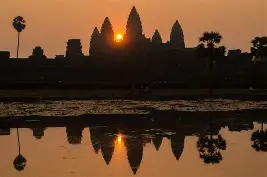
The famous sunrise over Angkor Wat has become one of the most iconic scenes in world tourism.
Yet Angkor is far more than a photo opportunity — understanding its history transforms the entire experience.
Visiting Angkor with a Local Tour
The Angkor Archaeological Park includes over 1,000 temples spread across a vast area.
Without guidance, many visitors miss the deeper meaning behind the structures.
A well-organized local tour allows travelers to:
understand the symbolism
discover hidden temples
optimize travel time
fully explore Angkor Wat, Angkor Thom, Ta Prohm, and more
👉 We offer professional Angkor tours in Siem Reap, with experienced drivers and customized itineraries.
Book your Siem Reap Angkor tour
Book via Telegram
An Eternal Legacy
Angkor Wat stands as a timeless message from the Khmer civilization.
Despite centuries of change, war, and nature, the temple remains a powerful symbol of faith, intelligence, and human creativity.
Visiting Angkor Wat means walking through more than 900 years of history, discovering one of the greatest cultural treasures on Earth